
CREDIT INFORMATION

Due to recent "Cyber Theft" and "Fraudulent Copyright Violations" please contact main office 936-756-0442

EMPLOYEE LIST

For employee information please contact main office 936-756-0442

David Heintz
President
A & H Electric Co.
3505 N. Loop 336 West
Conroe, Texas 77304
Office: (936) 756-0442

Open post Getting to Know Your Breaker Panel

Getting to Know Your Breaker Panel

Every home should be equipped with a break panel, these panels are just one big switch that is filled with smaller switches, called breakers. These switches help with a variety of things. You should really only need access to the breaker panel for these three tasks:

  • to reset a circuit breaker after it trips
  • to shut off power to the whole house, if needed
  • to turn off power to individual circuits when installing a ceiling fan or replacing an outlet

What am I looking at?

Electrical main: You can, in the case of an emergency, shut off electricity to your entire home using this switch. Located at the top of most boxes, it’s the biggest breaker, usually 100 to 200 amps, depending on the house’s square footage.

Single-pole breakers: These general-purpose breakers likely make up most of the breakers in your box. They can handle 120 volts and are either 15 amps or 20 amps (reference the numbers on top of the switches for proper amps).

Double-pole breakers: Like the electrical main, they look like two switches joined together. They can handle 240 volts and are usually between 15-125 amps. These are for your large appliances, such as stoves, dryers, HVAC units, and water heaters.

Expansion (empty) slots: Many breaker boxes have empty slots, so that you can have a licensed electrician add additional circuits, as needed. This comes in handy if you add a suite of new appliances to your kitchen or want to install covered outlets outdoors.

There are also other types of special purpose breakers, such as Arc Fault Circuit Interrupters (AFCI) and Ground Fault Circuit Interrupters (GFCI) that are designed to provide additional safety protection from fire (AFCI), and electrocution (GFCI).

Why do circuit breakers trip?

A circuit breaker “trips,” shutting off the flow of electricity, ensuring your appliances and/or home don’t become damaged due to an overheating circuit. Before flipping the switch back, it’s important to determine what caused the circuit breaker to trip in the first place. The number one cause is circuit overload (discussed below), however, other, more serious causes, include:

  • Short circuits
  • Ground faults

Overloading occurs when you power on too many devices at the same time on the same circuit. For example, if you have a 15 amp circuit powering your TV, microwave, and lights all on at the same time, then the circuit breaker will trip to prevent overheating because you’ve exceed the capacity of the electrical wiring. Overheating appliances can also cause a circuit to overload.

The solution? Hire a licensed electrician to come and replace the circuit breaker. You should also consider redistributing some of your lights, appliances, and other devices to another outlet to avoid overloading the circuit. Having a properly labeled panel is important, as well.

Open post Electrical Problems in the Summer & How to Keep a Lookout

Electrical Problems in the Summer & How to Keep a Lookout

Summer is officially only a couple of weeks away – long days, warm nights, and continuous enjoyment! 

Summer also brings in major heat waves throughout Texas and the best way to keep ourselves cool is by utilizing air conditioners. However, if you add in some humidity, this can cause several electrical problems this hot season that you should watch for, as well as contact a Houston electrical contractor to repair.

Summer Storms

Thunderstorms this season can interrupt power and depend on the severity of the storm, it can sometimes last for several days even. Contact your utility company and alert them of the outage in your home or area. If you have a generator stored at least 30 feet from your home, this can ensure some power during storms and not leave you in the dark until power can be reinstated. 

Generators are very useful, often coming in a range of fuel types like gas, propane, and diesel – some even have dual fuel tanks. Generators can be bought as portable or standby and some can be connected to your home’s existing liquid propane or natural gas fuel supply if you have that. With a wide range of power capacities, you can choose how mighty your generator will be.

Consumption Increase

Between June and August, the need for cooling greatly increases. On top of that, there is also an increase in lighting, appliances, and electronics. The best option is to try and conserve as much energy as possible. Before our current advancements, many would have to lower their air conditioning use or appliance usage but with today’s technologies, there are now energy-efficient products for everything in our homes. 

Other simple and cost-effective ways to save energy and money during Houston’s 90+ weather include:

  • Plug electronics into a power strip
  • Don’t heat your home with appliances
  • Caulk and weatherstrip around windows and doors
  • Check your air filter monthly, changing it as needed
  • Program your thermostat to save energy when you are asleep or away
  • Turn lights, fans, and electronics off when you leave a room or don’t need them

Contact a Certified Electrician in Conroe

A&H Electric Co. has over thirty years of experience providing residential and commercial electrical repair, maintenance, and installation. We offer a full suite of services, not limited to electrical safety inspections and whole home rewiring, with all work performed by experienced technicians. Please don’t hesitate to schedule an appointment anytime you need a certified electrician in Conroe to service your home or business, even if it’s after hours, as we offer 24-hour emergency repairs.

Join the A&H Electric Co. Family! A&H Electric Co. is currently looking for experienced electrical technicians to join our team. You must have prior experience providing residential and commercial electrical repair, maintenance, and installation. If you’re interested in becoming part of the A&H Electric family, please contact us at (936) 756-0442 or complete the online job application.

Open post certified electrician

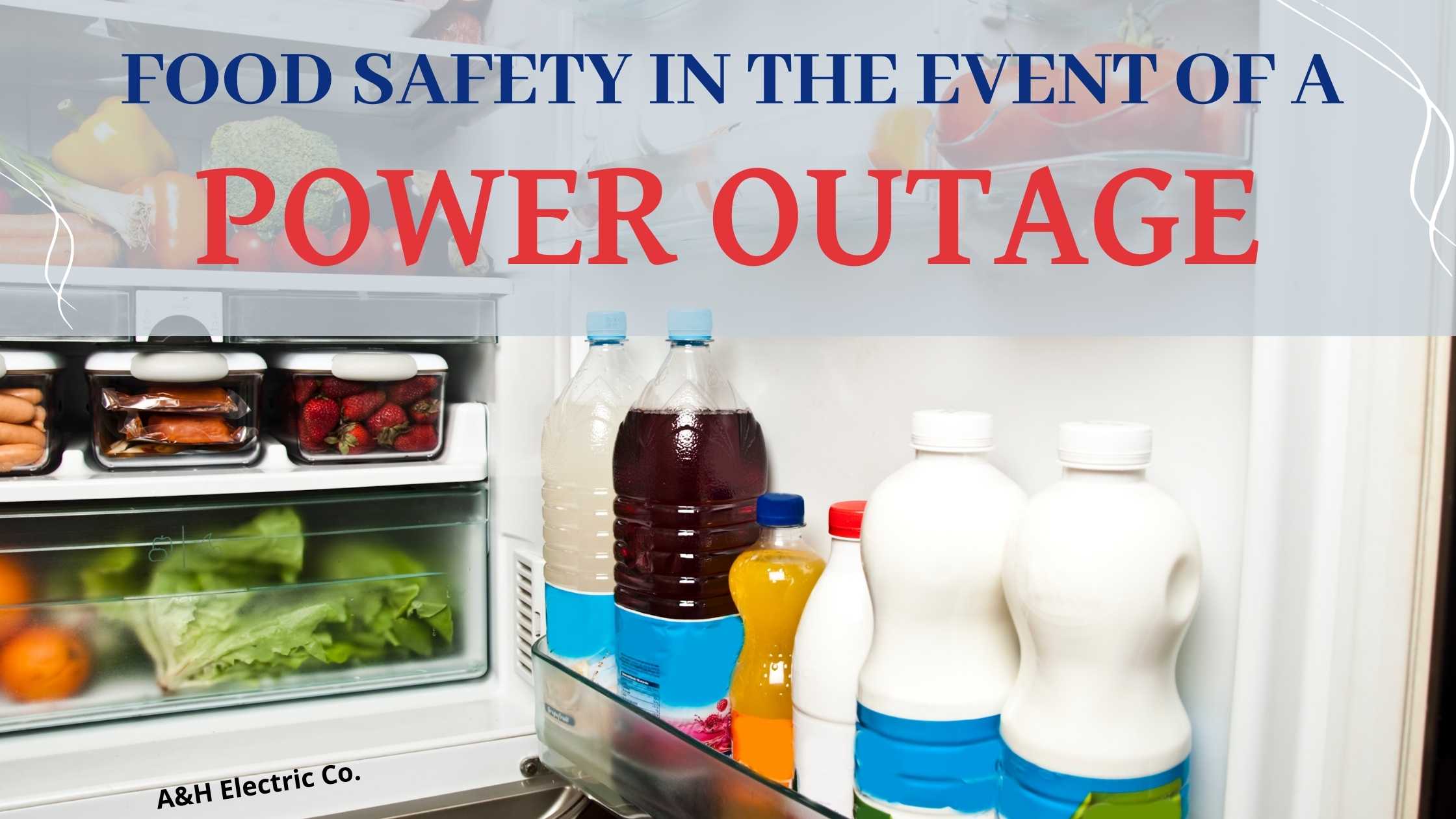
Food Safety in The Event of a Power Outage

Whether it’s from a powerful storm or extreme heat, when your house goes dark and quiet, there are specific things you should do to prevent refrigerated and frozen food from spoiling. That is particularly essential should the power outage extend past four hours as this is the time that the U.S. Department of Agriculture (USDA): Food Safety and Inspection Service says that perishable food will remain safe in the refrigerator, while a full freezer will hold its temperature for 48 hours – 24 if half-full, assuming the door stays closed until a certified electrician can restore power.

The agency also assumes that the fridge and freezer maintained temperatures of 40ºF or below and 0ºF or below. Ideally, you should purchase two appliance thermometers, placing one in the refrigerator and the other in the freezer to ensure those temperatures. Depending on the type, you can find these at the most popular retailers for under $20. A thermometer will be needed after power returns as well.

Should the temperature creep above the recommended degrees, bacteria can grow, potentially causing you to be at risk for foodborne illnesses once the food has been eaten. That is why the USDA encourages discarding any perishable food items if the temperature of your fridge is above 40ºF or your freezer is above 0ºF after a certified electrician has restored power to your community or residence. If you are uncertain about an item, play it safe by discarding it, especially if there’s an odor or color. The agency also cautions against tasting food as even a tiny amount may make you sick.

Consider a Whole House Generator

Unfortunately, power outages happen without notice, and those considered weather-related have been up 67 percent since 2000. That is according to the Department of Energy Data, as mentioned in by the USDA in their article, “Avoid Foodborne Illness During Temporary Power Outages.” While there are certainly ways to promote food safety before and during an outage, one of the best things you can do before the power goes out is to invest in a whole house generator, professionally installed by a certified electrician.

These devices are designed to deliver power to your home’s electrical panel, built to withstand the elements, and available with a host of additional features so that you never have to worry about opening the fridge and freezer, decreasing the time that your food will stay safe, during a power outage again. Also known as home standby generators, these devices start once they detect an outage, powering all your devices and appliances until power has been restored to your home. Remember that a certified electrician must professionally install these to ensure optimal operation.

Contact a Certified Electrician in Conroe

A&H Electric Co. has over thirty years of experience providing residential and commercial electrical repair, maintenance, and installation. We offer a full suite of services, not limited to electrical safety inspections and whole home rewiring, with all work performed by skilled technicians. Please don’t hesitate to schedule an appointment anytime you need a certified electrician to service your home or business, even if it’s after hours, as we offer 24-hour emergency repairs.

Join the A&H Electric Co. Family! A&H Electric Co. is currently looking for experienced electrical technicians. You must have experience providing residential and commercial electrical repair, maintenance, and installation. If you’re interested in filling one of our open positions, please contact us at (936) 756-0442 or complete the online job application.

We look forward to hearing from you soon!

Resources:

Carothers, Meredith. “Are You and Your Food Prepared for a Power Outage?” USDA, February 21, 2017.

“Food Safety During Power Outage.” U.S. Department of Health & Human Services, FoodSafety.gov, January 28, 2021.

“Food Safety for Power Outages.” Centers for Disease Control and Prevention (CDC), September 8, 2020.

Garcia, Jesus. “Avoid Foodborne Illness During Temporary Power Outages.” USDA, August 18, 2021.

Getting to Know Your Breaker Panel

Your breaker panel is just one big switch, filled with other smaller switches, called breakers. As a homeowner, you should only need to access the panel for these three tasks:

  • to reset a circuit breaker after it trips
  • to shut off power to the whole house if needed
  • to turn off power to individual circuits when installing a ceiling fan or replacing an outlet

What am I looking at?

Electrical main: You can, in the case of an emergency, shut off electricity to your entire home using this switch. Located at the top of most boxes, it’s the biggest breaker, usually 100 to 200 amps, depending on the house’s square footage.

Single-pole breakers: These general-purpose breakers likely make up most of the breakers in your box. They can handle 120 volts and are either 15 amps or 20 amps (reference the numbers on top of the switches for proper amps).

Double-pole breakers: Like the electrical main, they look like two switches joined together. They can handle 240 volts and are usually between 15-125 amps. These are for your large appliances, such as stoves, dryers, HVAC units, and water heaters.

Expansion (empty) slots: Many breaker boxes have empty slots, so that you can have a licensed electrician add additional circuits, as needed. This comes in handy if you add a suite of new appliances to your kitchen or want to install covered outlets outdoors.

There are also other types of special purpose breakers, such as Arc Fault Circuit Interrupters (AFCI) and Ground Fault Circuit Interrupters (GFCI) that are designed to provide additional safety protection from fire (AFCI), and electrocution (GFCI).

Why do circuit breakers trip?

A circuit breaker “trips,” shutting off the flow of electricity, ensuring your appliances and/or home don’t become damaged due to an overheating circuit. Before flipping the switch back, it’s important to determine what caused the circuit breaker to trip in the first place. The number one cause is circuit overload (discussed below), however, other, more serious causes, include:

  • Short circuits
  • Ground faults

Overloading occurs when you power on too many devices at the same time on the same circuit. For example, if you have a 15 amp circuit powering your TV, microwave, and lights all on at the same time, then the circuit breaker will trip to prevent overheating because you’ve exceed the capacity of the electrical wiring. Overheating appliances can also cause a circuit to overload.

The solution? Hire a licensed electrician to come and replace the circuit breaker. You should also consider redistributing some of your lights, appliances, and other devices to another outlet to avoid overloading the circuit. Having a properly labeled panel is important, as well.

Protect Your Home with a Whole-House Surge Protector

Each electronic device in your home, from your HVAC unit to your large screen television, and high-tech audio equipment has a microprocessor. Without adequate protection, power surges can destroy these microprocessors, rendering your home electronics and/or appliances completely useless. The cost to replace each damaged device is much more expensive than installing a whole-house surge protector.

Where do surges come from?

Power surges can originate from external and internal sources. External sources include lightning striking nearby circuits and the electric utility company switching power grids. These surges can enter the house through several pathways. Internally, power surges result when large appliances like air conditioners and refrigerators turn on and off their motors, decreasing the flow of power. Static electricity can also cause power surges.

Whole-House Surge Protectors

Type 1

A Type 1 Surge Protection Device (SPD), also known as a secondary surge arrestor, protects against external power surges, such as those caused by lightning striking utility equipment, tree limbs touching a power line or your power company switching power grids. They are typically installed on the line side of the main service entrance. They are your first line of defense against potentially damaging power surges.

Type 2

A Type 2 SPD, also known as panel protector, is installed at your branch panel (more commonly referred to as your breaker panel). Wired directly to a dual-pole breaker in your panel, type 2 surge protectors protect all the circuits in that panel, as well as any subpanels that might be connected downstream. They generally provide protection against surges originating from inside your home.

Type 3

This category is one you are probably already familiar with. Devices, such as power strips and battery backups with built-in surge protection, suppress the lower level voltage spikes that can be especially damaging to high-tech electronics (e.g, computers, audio components, Smart TVs, and other household electronics). Power strips should specify that they have surge protection capabilities to be considered an SPD.

A full-featured whole-house surge protector diverts power surges away from your home and into the ground. Look for an SPD with a minimum rating of 50kA (1kA equals 1,000-amps). You will also want to make sure the device you choose complies with the most recent UL rating. Contact a licensed electrician in your area for professional whole-house surge protection device installation.

Common Electrical Problems

common electrical problems

Why do my lights flicker?

This problem can be caused by several factors including plugging in an appliance that temporary draws more power causing the lights to flicker. Flickering lights are also often indicative of a defective or loose light bulb. If replacing or tightening the bulb doesn’t solve the problem, it is best to consult a licensed electrician, for expert diagnosis. The fault may be in the light fixture or its connections.

What is a GFCI device?

A GFCI or GFI is short for ground fault circuit interrupter. This inexpensive device is designed to protect you from severe electrical shocks. Through constant monitoring, a GFCI device immediately shuts off an electrical power circuit when it detects a differing flowing current along an unintended path, such as through water or a person. It can also shut off when outlets are overloaded to prevent electrical fires.

Why did my circuit breaker trip?

A circuit breaker plays a vital role in ensuring your safety by protecting the home from an electrical overload, which could damage your appliances, and ultimately result in an electrical fire. There are two conditions for circuit breakers tripping: 1) overloading and 2) short circuiting. It is common for older breakers (those 15 to 20 years old) to trip more often than newer circuits.

Why do my electrical outlets spark?

A brief spark may occur when power is suddenly diverted to an appliance. This is totally normal. However, if too much heat builds up in an outlet, the insulation can melt causing the wires to become exposed and ultimately increasing the risk for an electrical fire. This is known as a short circuit. Installation of a GFCI can prevent the overheating of electrical outlets thus ensuring your safety.

Why do my bulbs keep burning out so fast?

If you find yourself constantly changing light-bulbs, – at a rate of one every few weeks – you may be using a bulb with a higher wattage than your light fixture can handle. Check your light fixtures to make sure you’re using the correct wattage light bulbs. Other common causes include: too much voltage coming into your house, tightly screwed in light-bulbs, too much vibration, and poorly installed fixtures.

Whole House Generators: Powering on Demand

Some dangers rear their ugly head without any warning, as we have already evidenced with the United States’ recent natural disasters, but knowing this – knowing that danger is around every dark corner of the world – doesn’t mean we shouldn’t or can’t protect ourselves for its arrival.

In fact, when we prepare ourselves for dangerous situations, our chances of surviving increases significantly. Taking precautionary measures such as ensuring you’re not left in the dark for any extended period of time should a storm take out your electricity aids in your survival just as much as any other measure.

This is especially important for older adults. As well as those that may be more susceptible to hypothermia (below normal body temperatures) or hyperthermia (exceptionally high fevers) during intense cold or heat conditions. Ensuring your electricity remains on is also important for maintaining your quality of life.

Whole House Generators: Your Solution to Power Outages

One solution, which experts all seem to agree on, is whole house generators. While these type of generators can be quite expensive, when you consider the fact that 3.5 million Americans can be left without power in any given week, they just may be worth the expense.

The way whole house generators work is actually quite simple. Built to look much like an air conditioning unit, except for the fact that they are enclosed and are much larger, these types of generators power on automatically in the event your home goes off the grid.

They typically supply enough energy for your family to maintain your quality of life until the power is completely restored. And, although they’re expensive, they have the added benefit of increasing your home’s value; thus presenting you with the chance to net some of your expense back should you ever decide to move.

Whole House Generators: What You Should Look For

  • Generators come in a variety of sizes and workload capacities. You’ll want to ensure the one you purchase is capable of handling everything that you’ll want it to power until electricity is restored.
  • You should look for generators that have built-in transfer switches as this will ensure you don’t have to face the elements in order to turn the unit on by hand.
  • You should look for the highest quality units for maximum durability. Those that are made from stainless steel resist corrosion better than any other type of generator currently available.
  • These types of generators typically operate with the use of either natural gas or liquidized petroleum gas therefore its important to inquire about their fuel efficiency.
  • Whole house generators require professional installation. It is important to locate a professional electrician to ensure the proper placement and installation of your new unit.