CREDIT INFORMATION

Due to recent "Cyber Theft" and "Fraudulent Copyright Violations" please contact main office 936-756-0442

EMPLOYEE LIST

For employee information please contact main office 936-756-0442

David Heintz
President
A & H Electric Co.
3505 N. Loop 336 West
Conroe, Texas 77304
Office: (936) 756-0442

Open post Getting to Know Your Breaker Panel

Getting to Know Your Breaker Panel

Every home should be equipped with a break panel, these panels are just one big switch that is filled with smaller switches, called breakers. These switches help with a variety of things. You should really only need access to the breaker panel for these three tasks:

  • to reset a circuit breaker after it trips
  • to shut off power to the whole house, if needed
  • to turn off power to individual circuits when installing a ceiling fan or replacing an outlet

What am I looking at?

Electrical main: You can, in the case of an emergency, shut off electricity to your entire home using this switch. Located at the top of most boxes, it’s the biggest breaker, usually 100 to 200 amps, depending on the house’s square footage.

Single-pole breakers: These general-purpose breakers likely make up most of the breakers in your box. They can handle 120 volts and are either 15 amps or 20 amps (reference the numbers on top of the switches for proper amps).

Double-pole breakers: Like the electrical main, they look like two switches joined together. They can handle 240 volts and are usually between 15-125 amps. These are for your large appliances, such as stoves, dryers, HVAC units, and water heaters.

Expansion (empty) slots: Many breaker boxes have empty slots, so that you can have a licensed electrician add additional circuits, as needed. This comes in handy if you add a suite of new appliances to your kitchen or want to install covered outlets outdoors.

There are also other types of special purpose breakers, such as Arc Fault Circuit Interrupters (AFCI) and Ground Fault Circuit Interrupters (GFCI) that are designed to provide additional safety protection from fire (AFCI), and electrocution (GFCI).

Why do circuit breakers trip?

A circuit breaker “trips,” shutting off the flow of electricity, ensuring your appliances and/or home don’t become damaged due to an overheating circuit. Before flipping the switch back, it’s important to determine what caused the circuit breaker to trip in the first place. The number one cause is circuit overload (discussed below), however, other, more serious causes, include:

  • Short circuits
  • Ground faults

Overloading occurs when you power on too many devices at the same time on the same circuit. For example, if you have a 15 amp circuit powering your TV, microwave, and lights all on at the same time, then the circuit breaker will trip to prevent overheating because you’ve exceed the capacity of the electrical wiring. Overheating appliances can also cause a circuit to overload.

The solution? Hire a licensed electrician to come and replace the circuit breaker. You should also consider redistributing some of your lights, appliances, and other devices to another outlet to avoid overloading the circuit. Having a properly labeled panel is important, as well.

Open post residential electrician

Electrical Tips to Keep the Holidays Merry

The holidays are a joyous time brimming with family gatherings, seasonal events, and glistening displays. But, unfortunately, it is the time of year for increased expenses since you need to purchase holiday gifts, plan holiday feasts, and deck the halls. Fortunately, you can implement some energy-efficient and electrical safety tips like contacting a residential electrician when decorating this season, ensuring the holidays stay merry.

Illuminate Your Holidays Safely

There are many interior and exterior lights, from icicles to projectors, that you can use to illuminate your holidays. However, it is critical to carefully inspect them before use to ensure they are safe, whether new or old. You should check for broken bulbs, cracked sockets, loose connections, or frayed wires. Once they pass this inspection, it’s a good idea to plug them in, looking for issues.

Another essential factor to consider is whether the lights will be used in an indoor or outdoor holiday lighting display since not all are multi-purpose. Before hanging twinkling lights this season, differentiate interior/exterior products by checking the UL listed tag for the approved location or searching specifically for multi-purpose varieties marked with UL’s red holographic label.

The U.S. Fire Administration (USFA), in collaboration with the National Fire Protection Association (NFPA), also recommends reading the manufacturer’s instructions to determine how many strands can be safely connected in this year’s “Put a Freeze on Winter Holiday Fires” campaign. Taking preventative measures like these can help prevent electrical failures, which the NFPA says are a leading cause of residential fires.

Save Energy when Decorating

During the winter holidays, school-aged children are on break and distant relatives are visiting, which typically translates to increased energy consumption and higher utility costs. They are also a popular time to shop with the National Retail Federation (NRF), predicting substantial holiday sales as consumers spend a significant amount of money on decorations, gifts, and non-gift purchases.

There are several energy-efficient measures that you can do to save money, allowing you to divert those funds to better use, like having a residential electrician install more circuit breakers to prevent overloading the system as you light up your holiday displays. Energy-saving measures include choosing LED lights, using automatic timers, and turning appliances and electronics off when not being used.

The U.S. Department of Energy estimates that you can save approximately 30% on your energy bill while subsequently reducing environmental emissions by setting your thermostat to an efficient yet comfortable temperature during the winter. They also recommend using a programmable or learning thermostat that will lower the heat further when you’re sleeping or away from home.

Need Electrical Repair? Consult a Licensed Electrician

Electrical issues are a significant cause for concern, particularly between November and February. The NFPA says that two out of five residential fires caused by electrical failure or malfunction occurred during this time. So should anything seem amiss as you’re decking the holidays, don’t delay; consult a licensed electrician like A&H Electric to troubleshoot the issues and make the necessary repairs.

A&H Electric Co. has over thirty years of experience providing residential and commercial electrical repair, service, and installation. We offer a full suite of services, not limited to electrical safety inspections and surge protection installation, with all work performed by certified electricians. Please don’t hesitate to make a service appointment with A&H Electric whenever you need a commercial or residential electrician to service your home or business, even if it’s after hours, as we provide 24-hour emergency electrical services.

Employment Opportunities! A&H Electric Co. is currently looking for technicians skilled in residential and commercial electrical repair, service, and installation. If you’re interested in joining our team and would like more information about available positions, please contact us at (936) 756-0442 or complete our online job application.

Resources:

Energy Saver. “Home Heating Systems.” U.S. Department of Energy.

Energy Saver. “Reduce Waste and Save Energy This Holiday Season.” U.S. Department of Energy, December 7, 2021.

Energy Saver. “Thermostats.” U.S. Department of Energy.

Inman, Danielle. “Holiday Spending Reflects Continued Consumer Demand.” National Retail Federation (NRF), October 21, 2021.

“Put a Freeze on Winter Holiday Fires.” U.S. Fire Administration (USFA) and National Fire Protection Association (NFPA).

Tassone, Anthony T. “Bulletin: Decorative Lighting Strings.” UL, July 24, 2017.

Open post electrical grounding rod

What is Electrical Grounding?

Electrical grounding, also known simply as grounding, refers to “intentionally creating a low-resistance path to the earth. When properly done, current from a short or from lightning follows this path, thus preventing the buildup of voltages that would otherwise result in electrical shock…” (“Grounding,” n.d.). Grounding systems for residential and commercial properties typically consist of a professionally installed electrical grounding rod.

Electrical grounding is crucial for ensuring your safety. The National Electrical Code (NEC) 2020 of Texas has specific requirements for grounding, including permitted electric grounding rods or electrodes and the depth at which they should be installed. Certified electricians are proficient with these and additional NEC codes. That means you can be assured that your electrical grounding rod will perform safely and reliably when installed by a certified electrician.

Electrical Grounding Rod

The NEC specifies in Article 250, specifically 250.52, that rod-type grounding electrodes must be a minimum of eight feet long and 5/8 inches in diameter. They must also consist of stainless steel and copper or zinc-coated steel as these materials provide excellent conductive properties and corrosion resistance.

Alternatively, grounding electrodes composed of either pipe or conduit must be metal-coated for protection against corrosion, with a minimum diameter of 3/4 inches. The required length for this application type remains eight feet long.

A certified electrician must professionally install these systems. Ground-fault circuit interrupters (GFCIs) are also recommended, particularly in moist areas like kitchens and bathrooms, and should be considered in new builds and remodels. GFCIs are designed to disconnect power to a device if the current exceeds the values established. 

Electric Repair, Service, and Installation 

With over thirty years of experience in Montgomery County, TX, A&H Electric Co. is your local certified and licensed electrical service, repair, and installation company. We specialize in commercial and residential electrical services, including electric ground rod installation.

Our electronic contractors can install, repair, or service your electrical system Monday through Friday from 7:00 AM to 5:00 PM. We also provide 24-hour emergency repair. We invite you to schedule a service appointment with an expert, certified, and licensed electrician today.

Resources:

NFPA 70, 2020, National Electrical Code of Texas. “Article 250: Grounding and Bonding.” UpCodes, 2020.

NFPA 70, 2020, National Electrical Code of Texas. “Chapter 1: General – 100 – Definitions. UpCodes, 2020.

The Home Depot. “What is Grounding vs. Bonding.” n.d.

United States Department of Labor, Occupational Safety and Health Administration, OSHA. “Grounding.” n.d.

Open post licensed electrician

3 Reasons to Upgrade Your Electrical Panel

As people purchase more electronics, possibly even adding a new appliance here and there, older electrical panels may not keep up with demand. That can create problems, such as breakers frequently tripping due to overloading the available circuits. Having a licensed electrician upgrade your electrical panel can solve this problem and prevent more substantial, perhaps even dangerous, issues from occurring.

Safety First

According to the National Fire Protection Association (NFPA), electrical failures or malfunctions were responsible for more than forty-four thousand residential fires each year between 2012 and 2016, making them the second-leading cause of home fires. Electrical distribution, lighting, and power transfer equipment accounted for half of these. Aging electrical systems, arc faults, short circuits, and overloaded circuits can contribute to electrical fires and should be mitigated by contacting a licensed electrician. 

Increasing Amperage

Inside every panel is the main breaker, which shuts off ALL power to the residence, along with several circuit breakers and bus bars. You can identify the panel’s current amperage capacity by looking at the main breaker. To increase this capacity or have dedicated circuits installed, as required by the National Electrical Code (NEC) for major appliances, a licensed electrician will need to rewire your home and upgrade the panel.

Energy-Efficient Upgrades

There are a few energy-efficient upgrades for electrical panels, including intelligent circuit breakers, that can monitor the power your appliances and electronics are consuming. That will allow you to make wise decisions so that you can save money on future energy bills. Like Leviton’s new smart load center, some of the more recent products on the market can also instantly alert you to a tripped breaker (Gartenberg, 2019). Another option is an after-market smart energy meter that a licensed electrician can connect to a specific circuit to monitor the amount of power a single appliance or electronic is using. Whole-home monitors are also available.

Contact a Licensed Electrician to Upgrade Today

A&H Electric Co. is a certified and licensed electrician specializing in residential and commercial installation, service, and repair. Our company services the Conroe, Houston, and The Woodlands area during regular business hours and, because we understand that emergencies happen, offers 24-hour repair.

Please contact us at (936) 756-0442 to schedule a service appointment.

Our electrical contractors possess the equipment and expertise necessary to upgrade your electrical panels when the need arises and ensure your system is fully operational. Plus, we are committed to standing behind our workmanship, with a full one-year warranty on all projects.

A&H Electric is currently hiring! Please click here to view and apply for our company’s open employment opportunities.

Resources:

Campbell, Richard. “Home Electrical Fires.” The National Fire Protection Association (NFPA), March 2019.

Gartenberg, Chaim. “Leviton’s new smart Load Center brings app control to your circuit breakers.” The Verge, February 19, 2019.

“How to Buy Electrical Panels.” The Home Depot.

Open post residential wiring

Common Residential Wiring Problems

With temperatures in the 90s, Texans are relying on their air conditioners to help keep them cool and comfortable, so the last thing anyone wants to deal with is residential wiring problems. If your lights flicker each time the air conditioner or another major appliance kicks on, or you’re using too many surge protectors to power your work-from-home equipment, then its advisable to contact a certified electrician. These may be signs that your house has a wiring issue.

Flickering Lights

There are several reasons for the lights in your home to flicker. It may be a simple fix, such as a loose bulb or faulty fixture, or something far more complex. Do the lights flash in response to turning on the light or powering on an appliance? Then there may be a problem with either your electric current or wiring, both of which are best left addressed by a certified electrician.

Not Enough Outlets

Having an inadequate number of outlets to power all your gadgets – especially if you’re still working remotely – increases the need to rely on surge protectors. While no electrical problem exists with this habit, if you’re not overloading the circuit, you may want to consider contacting an electrician. An electrician can wire new outlets, including GFCIs and those with built-in USB Type C ports, for the ultimate in charging convenience.

Unwanted Visitors

Rodents love to find warm places to hang their “home sweet home” sign. They can make their nests in walls, crawlspaces, and other areas where they can chew through your wiring. If you see or hear any activity in your walls, it’s essential to contact a trap company, and if you’re experiencing problems with your electric system, an electrician to repair any diagnosed damage.

Residential Electrical Services

From residential wiring to repair, A&H Electric can expertly handle all your electrical projects, regardless of complexity. There is no job too big or small for our licensed and insured electricians. The following is a shortlist of the services we provide to homeowners throughout Conroe and neighboring communities.

  • Whole-house generator installation
  • Breaker panel and circuit service
  • Lighting installation and repair
  • Outlet and switch installation
  • ARC-fault breaker installation
  • Home electrical safety checks
  • Upgrade electrical service
  • Surge protection
  • Code corrections
  • New wiring

Upon arrival, a certified electrician will troubleshoot any issues, identifying the root cause of the problem. You’ll be provided with an explanation of their findings in which you’re welcome to ask any questions, as well as their recommendation, along with an upfront estimated cost and time scheduled so that you may make an informed decision.

Residential Wiring Installation, Service, & Repair

It is essential to have a certified electrician, like A&H Electric, complete all electrical work to ensure your system is up to code and operating reliably and safely. Schedule an appointment with an electrical contractor experienced in residential wiring installation, service, and repair today at (936) 756-0442. A&H Electric is a certified residential and commercial electrician specializing in installation, service, and repair. Our company is proud to offer our services in Conroe and the surrounding communities of Texas.

Open post Power-Your-Outdoor-Living-Spaces

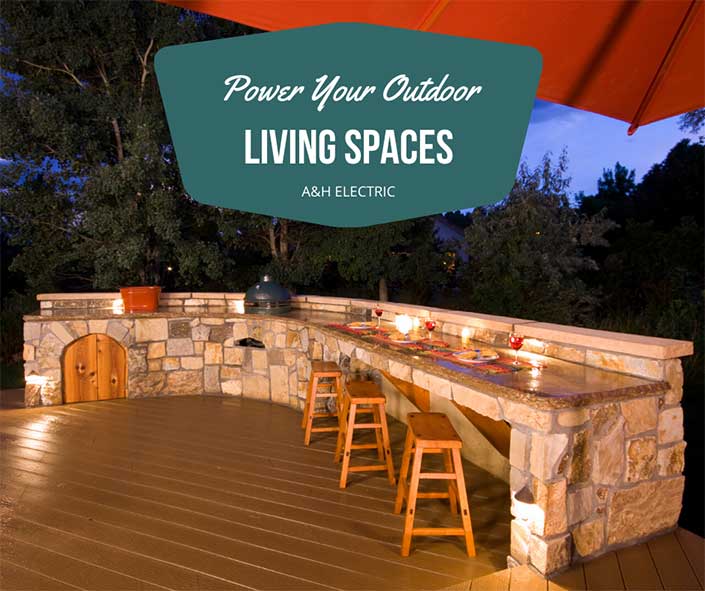
Power Your Outdoor Living Spaces

Imagine dining under the stars, having a backyard movie night, or unwinding next to the warmth of a outdoor fireplace. If these activities appeal to you, you may want to consider extending your living space outdoors. No shortage of interior features can be created outdoors, assuming a professional, certified electrician has completed the proper electrical work.

Electricity changes the name of the game in outdoor living spaces. Having a certified electrician provide electrical work allows you to power exterior kitchen appliances, big-screen televisions, pool and spa equipment, and electric fireplaces. Inspiration for outdoor living spaces can be found on Pinterest and home improvement sites.

Making sure that there is an adequate number of outlets is equally essential for plugging in all your gadgets, whether portable or stationary, so that there is little reason to head inside. Another factor to consider is the installation of lighting and ceiling fans. The latter will make it much more comfortable for you to spend time outside during the Texas summer.

Required Electrical Work

The type of electrical work you’ll need will ultimately depend on what you desire in an outdoor space. Let’s say you want a functional kitchen for cooking family dinners without heating the entire house. The appliances required for building this type of outdoor living space must comply with local codes. Your home may also need to be rewired to accommodate any new equipment.

The National Electrical Code (NEC) requires ground fault circuit interrupters (GFCI) outdoors. These devices are designed to trip the circuit breaker in the event of a ground-fault. For additional NEC and local code requirements, consult a certified electrical contractor, such as A&H Electric. 

Contact a Certified Electrician Today

Have a certified electrician complete all electrical work to ensure your system is operating reliably and safely. Schedule an appointment with an electrical contractor today at (936) 756-0442. A&H Electric is a certified residential and commercial electrician specializing in installation, repair, and service. Our company services Conroe and the surrounding communities of Texas.

Resources:

“Electrical Circuit-Interrupters.” National Fire Protection Association, nfpa.org/Public-Education/Fire-causes-and-risks/Top-fire-causes/Electrical/Electrical-circuit-interrupters.

Phantom Loads Revealed

phantom loads

The electricity consumed by common home gadgets and appliances despite being switched off is referred as phantom loads. The convenience popular products afford you comes with a price tag. According to a 2015 report by the Natural Resources Defenses Council (NRDC), plugged-in devices continually draw power, costing you $165 annually and increasing your carbon footprint.

Banish household phantoms and effectively lower your energy consumption.

Phantom Loads Revealed

There’s no shortage of electronic gadgets in the average home. That said, the most notorious phantoms are those with digital displays, speakers and remote controls. You’ll likely find most of these devices centered in or around your entertainment center or home office. Some of the biggest offenders include set-top boxes, televisions, desktop computers or laptops, and gaming consoles.

Banish Phantom Loads Once and for All

The best way to banish household phantoms is to simply unplug all electronics and appliances when not in use. While this is effective enough in theory, walking around a 2,436 square foot home, on average, unplugging dozens of devices may not be very practical or efficient.

Enter surge protectors!

They may look the same, but power strips and surge protectors are not alike. The latter expands the electrical outlets in your home, sure, but it also adds a layer of protection between your equipment and power surges. Many of today’s surge protectors feature automatic shutoff, USB ports (bye-bye bulky energy wasting chargers!), and coax ports.

To cut off the phantom load, you must manually turn-off the surge protector.

A cost-effective alternative is a smart surge protector, also known as an energy-efficient surge protector. This type automatically cuts power to the devices each time they are switched off. Surge protectors can be found at most any electronics store, big box retailer, and online. To avoid the risk of overloading them, make sure to buy a few.

A&H Electric specializes in the installation, repair, and service of all electrical systems in both commercial and residential properties throughout Conroe and the surrounding areas of Texas. Schedule an appointment with a licensed electrician today to discuss additional ways to save energy in your home or business.

Getting to Know Your Breaker Panel

Your breaker panel is just one big switch, filled with other smaller switches, called breakers. As a homeowner, you should only need to access the panel for these three tasks:

  • to reset a circuit breaker after it trips
  • to shut off power to the whole house if needed
  • to turn off power to individual circuits when installing a ceiling fan or replacing an outlet

What am I looking at?

Electrical main: You can, in the case of an emergency, shut off electricity to your entire home using this switch. Located at the top of most boxes, it’s the biggest breaker, usually 100 to 200 amps, depending on the house’s square footage.

Single-pole breakers: These general-purpose breakers likely make up most of the breakers in your box. They can handle 120 volts and are either 15 amps or 20 amps (reference the numbers on top of the switches for proper amps).

Double-pole breakers: Like the electrical main, they look like two switches joined together. They can handle 240 volts and are usually between 15-125 amps. These are for your large appliances, such as stoves, dryers, HVAC units, and water heaters.

Expansion (empty) slots: Many breaker boxes have empty slots, so that you can have a licensed electrician add additional circuits, as needed. This comes in handy if you add a suite of new appliances to your kitchen or want to install covered outlets outdoors.

There are also other types of special purpose breakers, such as Arc Fault Circuit Interrupters (AFCI) and Ground Fault Circuit Interrupters (GFCI) that are designed to provide additional safety protection from fire (AFCI), and electrocution (GFCI).

Why do circuit breakers trip?

A circuit breaker “trips,” shutting off the flow of electricity, ensuring your appliances and/or home don’t become damaged due to an overheating circuit. Before flipping the switch back, it’s important to determine what caused the circuit breaker to trip in the first place. The number one cause is circuit overload (discussed below), however, other, more serious causes, include:

  • Short circuits
  • Ground faults

Overloading occurs when you power on too many devices at the same time on the same circuit. For example, if you have a 15 amp circuit powering your TV, microwave, and lights all on at the same time, then the circuit breaker will trip to prevent overheating because you’ve exceed the capacity of the electrical wiring. Overheating appliances can also cause a circuit to overload.

The solution? Hire a licensed electrician to come and replace the circuit breaker. You should also consider redistributing some of your lights, appliances, and other devices to another outlet to avoid overloading the circuit. Having a properly labeled panel is important, as well.

Common Electrical Problems

common electrical problems

Why do my lights flicker?

This problem can be caused by several factors including plugging in an appliance that temporary draws more power causing the lights to flicker. Flickering lights are also often indicative of a defective or loose light bulb. If replacing or tightening the bulb doesn’t solve the problem, it is best to consult a licensed electrician, for expert diagnosis. The fault may be in the light fixture or its connections.

What is a GFCI device?

A GFCI or GFI is short for ground fault circuit interrupter. This inexpensive device is designed to protect you from severe electrical shocks. Through constant monitoring, a GFCI device immediately shuts off an electrical power circuit when it detects a differing flowing current along an unintended path, such as through water or a person. It can also shut off when outlets are overloaded to prevent electrical fires.

Why did my circuit breaker trip?

A circuit breaker plays a vital role in ensuring your safety by protecting the home from an electrical overload, which could damage your appliances, and ultimately result in an electrical fire. There are two conditions for circuit breakers tripping: 1) overloading and 2) short circuiting. It is common for older breakers (those 15 to 20 years old) to trip more often than newer circuits.

Why do my electrical outlets spark?

A brief spark may occur when power is suddenly diverted to an appliance. This is totally normal. However, if too much heat builds up in an outlet, the insulation can melt causing the wires to become exposed and ultimately increasing the risk for an electrical fire. This is known as a short circuit. Installation of a GFCI can prevent the overheating of electrical outlets thus ensuring your safety.

Why do my bulbs keep burning out so fast?

If you find yourself constantly changing light-bulbs, – at a rate of one every few weeks – you may be using a bulb with a higher wattage than your light fixture can handle. Check your light fixtures to make sure you’re using the correct wattage light bulbs. Other common causes include: too much voltage coming into your house, tightly screwed in light-bulbs, too much vibration, and poorly installed fixtures.

Are You Protected Against Power Surges?

Do you have expensive electronics such as big screen TVs, bluray players, and gaming consoles? Then you need a surge protector! Surge protectors, which aren’t necessarily the same as power strips, can keep all of your electronics and appliances safe from becoming useless due to a power surge.

Dangerous Power Surges & Spikes

Your home’s electrical sockets were designed to provide a consistent amount of voltage; which your electronics depend on for power. An increase in the amount of voltage they receive, no matter how short, can have devastating effects on both your electronics and wallet.

What causes power surges? Power surges are often the result of lightning strikes, power outages, and malfunctions in the power grid (your electricity company is responsible for maintaining the grid). Surges tend to last at least three nanoseconds. Anything less than that is considered a spike.

Power surges can, unfortunately, break down the electronics’ circuit board, wires, or both – no matter how old (or new) it may have been. The increase in voltage can render them completely inoperable. Damaged upon repair the only remedy is replacement.

So How Do You Protect Yourself?

You install a surge protector of course! Surge protectors, which easily connect to a standard electrical outlet, can safeguard you from a power surge’s potentially devastating results. Relatively inexpensive, surge protectors generally come in a magnitude of sizes; even travel sizes.

I personally have one that was designed to fit 10 devices plus my modem’s coax cables (in and out). Surge protectors work by diverting the energy over the safe threshold to a protective componenent that ensures only the safe amount of voltage reaches your electronics.

For the peace-of-mind you’ll receive – surges protectors are priceless!